Disclosure: This post contains affiliate/referral links. If you sign up through one, I may earn a small commission or service credit at no extra cost to you. I only recommend gear I actually use. See the full Affiliate Disclosure.
This is part of The Agentic RVer series — what it actually costs to work full-time from an RV in 2026.
Nobody who sells the RV lifestyle talks about the gas bill. I am going to talk about the gas bill.
My wife and I have been boondocking in Tennessee for about a month, both working remotely. We run two RVs, two generators, one Starlink dish, and enough electronics to keep us both on video calls all day. Here is what that actually costs in fuel.
Our Two Generators
We run a Westinghouse 4500W portable generator for the travel trailer where I work, and an Onan 4000W built-in generator on the Thor Compass 23TW where my wife works and we live.
The Onan is nice because it is built into the RV — you press a button and it starts. The Westinghouse is portable, which means I can place it far enough away that you can barely hear it during conference calls. Both have their advantages.
One thing I learned the hard way: the Onan runs off the RV’s main fuel tank. Same gas that drives the vehicle. I ran the generator for over a week straight without thinking about it, and one day it just stopped. Would not restart. Took me a while to figure out that the RV was almost out of gas — the generator auto-shuts off at a low fuel threshold so you can still drive to a gas station. Lesson learned. Watch your fuel gauge.
The Real Fuel Numbers
| Generator | Daily Fuel (No AC) | Daily Fuel (With AC) |
|---|---|---|
| Westinghouse 4500W | ~5 gallons/day | ~8-10 gallons/day |
| Onan 4000W | ~3-4 gallons/day | ~6-8 gallons/day |
| Both combined | ~8-9 gallons/day | ~14-18 gallons/day |
At $3.50 a gallon in rural Tennessee right now, that is $28-63 per day just for generator fuel. Let that sink in.
The Fuel Run
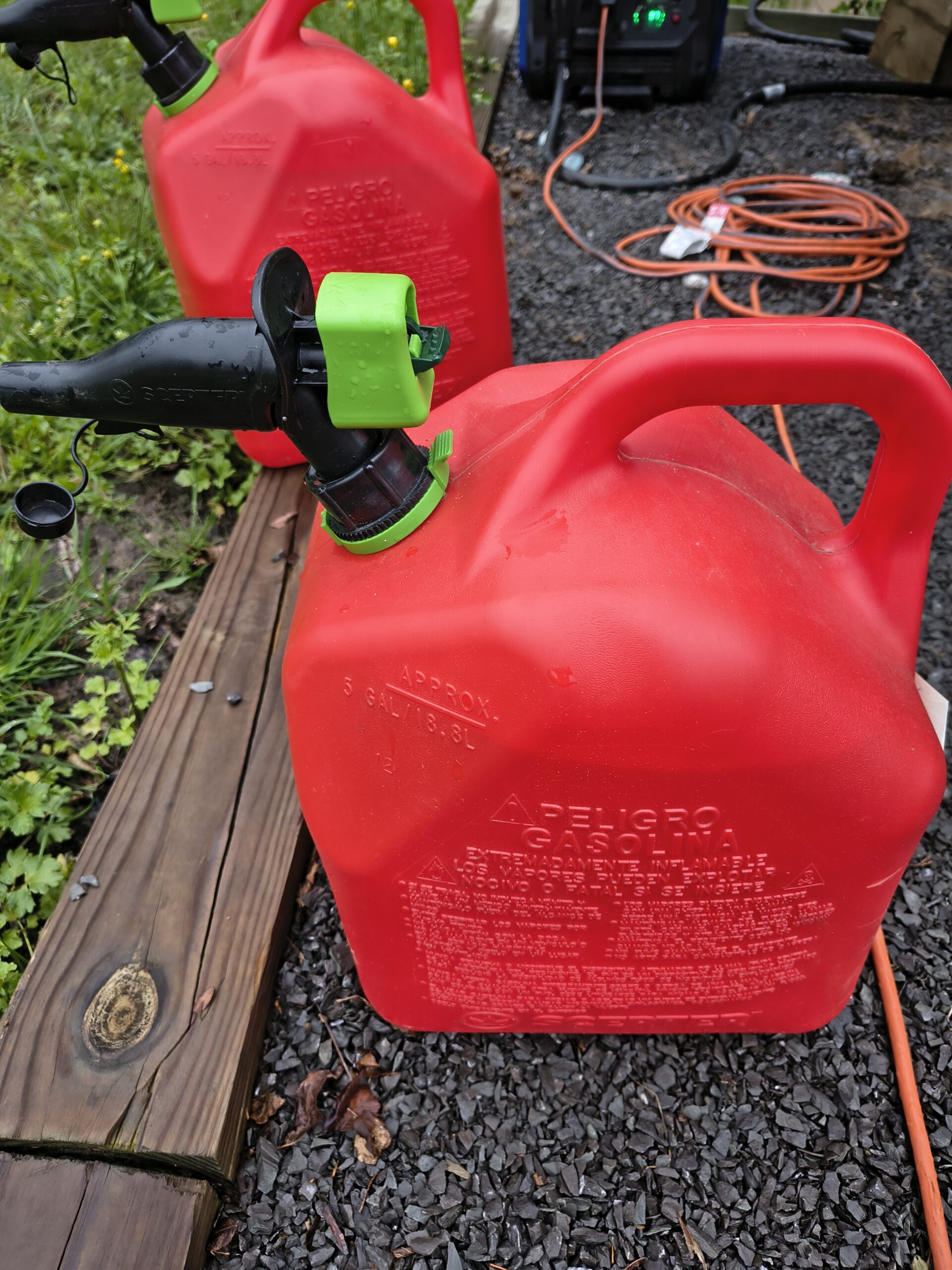
I drive into town about every 3-4 days with red 5-gallon gas cans. Town is about 7 miles away. The whole trip takes about 30 minutes — 10 minutes each way plus 5-10 minutes filling up. Usually we pick up drinking water or groceries at the same time to make the trip count.
It is not a big deal on any single day. But it adds up. That is 2 fuel runs per week, 30 minutes each, plus the cost of the gas itself.
Three Cost Seasons
If you are thinking about boondocking in the Southeast, understand that your fuel costs change dramatically by season:
| Season | What Happens | Fuel Impact |
|---|---|---|
| Spring/Fall | Mild temps, AC only a couple hours midday | Baseline — the numbers above |
| Summer | AC running nonstop, both RVs | Double or triple the baseline |
| Winter | Propane heater running overnight | 30-lb propane tank lasted about 3 weeks with lows in the 30s-40s |
Right now in April we are in the sweet spot. Open the windows most of the day, run AC maybe 2 hours when it hits the 80s. Summer in Tennessee would be a completely different story — and a completely different budget.
The Weekly and Monthly Cost
| Expense | Weekly Cost |
|---|---|
| Generator fuel (spring, minimal AC) | $200-315 |
| Generator fuel (summer, constant AC) | $340-440+ |
| Starlink unlimited | ~$35-40 ($150-160/month) |
| Propane (cooking, water heater) | $15-30 |
| Dump station fees | $10-25 per visit |
| Groceries | $150-200 |
| Total (spring) | $410-610 |
| Total (summer) | $550-735+ |
That is $1,600-2,900 per month. For context, a furnished apartment in Chattanooga — 30 minutes from where I am sitting — runs about $1,200-1,500 per month with utilities included.
Boondocking is not cheap. It is a lifestyle choice. Know the number before you commit to it.
What About Solar?
I have EcoFlow 200W solar panels at home that I did not bring on this trip. That was a mistake. Even at real-world output of maybe 100 watts, that is a slow trickle of free power all day. The math: 100W times 6 hours of sun equals 600Wh — that is half my EcoFlow battery. On a mild day, solar could eliminate the midday generator run entirely.
Solar does not replace generators for AC — you would need a massive array for that. But for keeping the battery topped up and running your work equipment? It pencils out. I will bring the panels next time.
The One Generator Mistake
In the beginning I tried to run both RVs off one generator to save fuel. The Westinghouse 4500W should be enough, right? Both RVs need a 30-amp plug. They make a splitter for that.
It did not work. Two air conditioners on one 4500W generator was too much. Constant overload trips. I could not find the 30-amp splitter locally anyway. I ended up just running each RV on its own generator — more fuel, but no more overload problems.
If you are setting up a two-RV camp, plan for two generators. The math does not work on a single unit when both need AC.
The Bottom Line
Generator fuel is the single biggest ongoing expense of boondocking. More than food. More than Starlink. More than dump fees. It is the cost that catches people off guard because nobody talks about it in the RV influencer world.
Know your daily burn rate. Know your weekly budget. And watch your fuel gauge — especially if your generator shares a tank with your engine.
Coming Next
- The Two-RV Office — why one RV is not enough when two people work full-time
- Mice, Mud, and Meetings — the unautomatable side of remote work
Dominic Ferrara is a Senior IT Manager working remotely from a boondocking camp in Tennessee. He writes about remote work, AI tools, and off-grid life at dominicferrara.com.
Transparency: Articles on this site are written with AI assistance (Claude Code) and reviewed, edited, and fact-checked by Dominic Ferrara based on personal experience. All data points are from actual field measurements and real-world use.
More From the Agentic RVer Series
- Agentic in the Terminal, Manual at the Spigot
- Your AC Will Kill Your Starlink
- The 72-Hour Clock
- Mice, Mud, and Meetings
- AI for RV Road Trip Planning
Get stories like this every week. Subscribe to AI After 50 — free weekly stories from the intersection of AI, health, and real life after 50.