Disclosure: This post contains affiliate/referral links. If you sign up through one, I may earn a small commission or service credit at no extra cost to you. I only recommend gear I actually use. See the full Affiliate Disclosure.
This is part of The Agentic RVer series — what it actually takes to work full-time from an RV in 2026.
When my wife and I first talked about working remotely from an RV, the assumption was we would share one rig. One RV, one space, both of us working. That lasted about a day before we realized it was not going to work.
She is a court reporter. I am a senior IT manager. Both of us are on calls all day — her on live legal proceedings, me on Teams and Zoom meetings. You cannot have two people on separate conference calls in a 200-square-foot space. The audio bleeds, the background noise is unprofessional, and neither person can focus.
So we set up two RVs. And honestly, it is the best decision we made for this whole arrangement.
The Layout
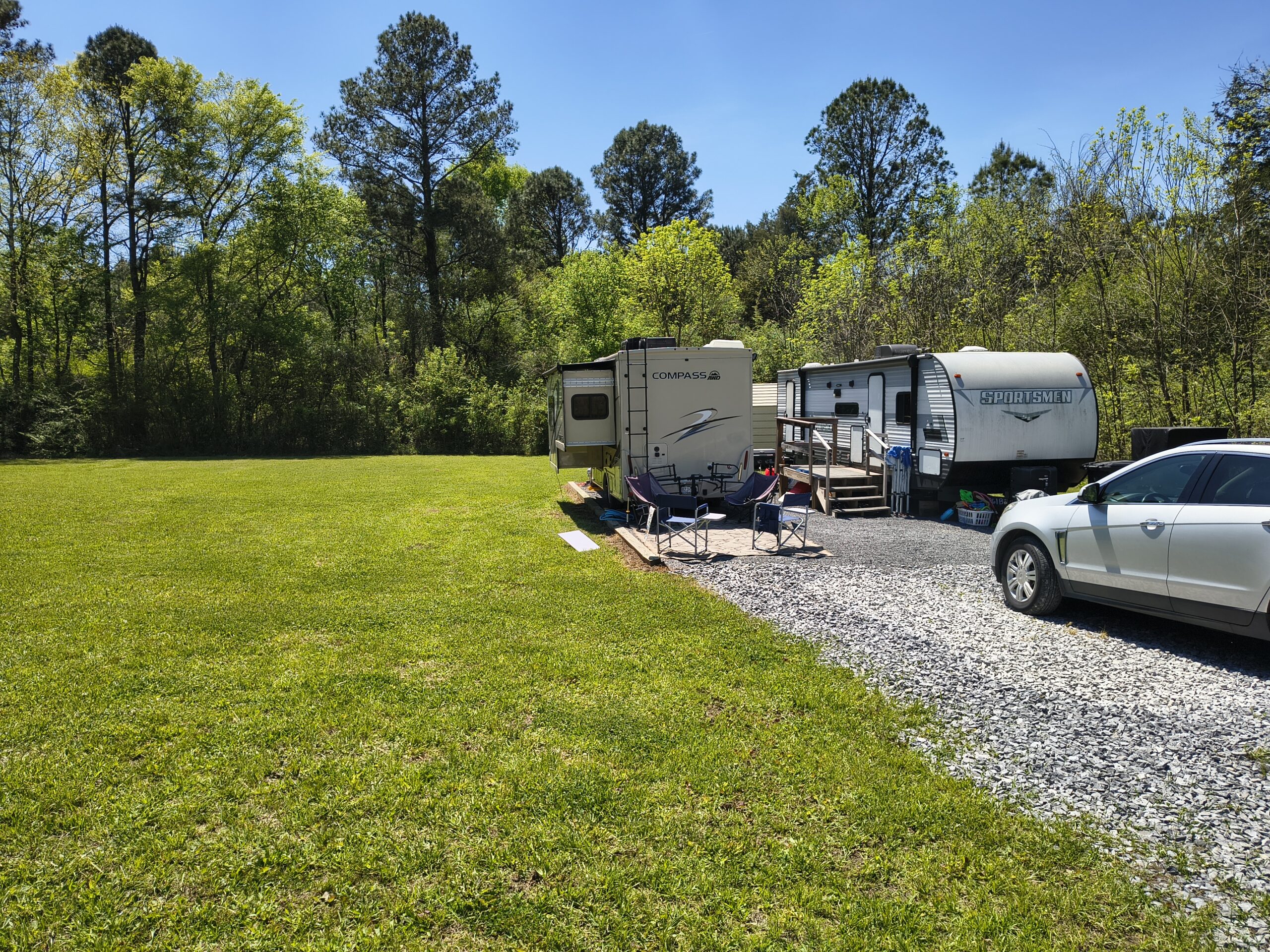
We are on a gravel pad on family property in Tennessee. About 2.5 acres of grass around us. The two RVs are parked about 10 feet apart:
- Thor Compass 23TW — my wife’s workspace and our living quarters. This is where we sleep, cook, and she works during the day.
- Travel trailer — my dedicated office. I work here all day, separate from the living space.
Both share one Starlink dish that covers the whole camp. Both have their own generator. Both run independently.
Why Two RVs Actually Work
Audio Isolation
This is the main reason. My wife’s court reporting work is live legal proceedings. She cannot have background noise. She cannot have my voice bleeding through from a Teams call. And I cannot be on a call with my leadership team while someone is transcribing testimony 8 feet away.
With two RVs, the walls do the work. I can be on a video call in my office and she can be on a live proceeding in hers. Neither of us hears the other. Problem solved.
Professional Separation
There is something about walking to a separate space for work that changes your mindset. When I step into the travel trailer in the morning, I am at work. When I step out in the evening, I am home. In one RV, work and life blur together in a way that gets exhausting fast.
Noise Management with Generators
The Thor Compass has a built-in Onan 4000W generator. It is right there — you can hear it, but it is manageable for calls. The Westinghouse 4500W is portable, so I can place it far enough from the travel trailer that I can barely hear it during my conference calls.
If both generators are running at the same time next to the same RV, it would be too loud for professional calls. Having them separated — one built-in, one placed at a distance — keeps the noise manageable for both of us.
The One-Generator Mistake
I tried to save fuel by running both RVs off the Westinghouse 4500W. Both need 30-amp connections. They make a splitter for that, but I could not find one locally.
Even if I had found the splitter, it would not have worked. Two RV air conditioners pulling from one 4500W generator was too much. The generator kept tripping on overload. The math just does not support it — each AC unit needs 1,200-1,500 watts running, plus a 3,000-4,500 watt inrush spike when the compressor starts. Two of those on one generator is asking for trouble.
We ended up running each RV on its own generator. More fuel, but zero overload problems. Sometimes the simple solution is the right one.
Sharing One Starlink
Both RVs share a single Starlink dish sitting on the ground between them. At 10 feet apart, the WiFi signal covers both spaces without issue. We get about 250 Mbps down and 50 Mbps up.
My wife runs live court reporting — audio and video streaming, sustained, no interruptions allowed. I run AI coding agents, video calls, and stream TV in the evenings. All of that simultaneously on one Starlink dish. No buffering. No dropped connections.
If you told me a year ago that one satellite dish in a Tennessee field could support two full-time remote professionals plus entertainment streaming at the same time, I would not have believed it. But here we are.
The Division of Labor
When you are running a two-RV camp, there is a lot of non-work work to do. My wife and I split it up based on what makes sense:
- Me: Generators (fueling, maintenance, starting), water (filling, dumping), power management (EcoFlow charging, Starlink), fuel runs into town
- My wife: Interior organization, cooking, cleaning, managing the living space
An RV is a small space. You are constantly shuffling things around, reorganizing, trying to remember where you put your keys. And you have keys for everything — the RV, the truck, the generator compartment, storage bays. I lose my keys at least once a day because nothing has a permanent spot yet. The more you can assign a place for every item, the better. I am still working on that.
Would One RV Work?
For one person working remotely? Absolutely. One RV with Starlink and an EcoFlow battery is a solid remote office.
For two people both working full-time with calls? No. Not unless one of you has a job that requires no audio — pure typing, no meetings, no calls. The moment both of you are talking at the same time, you need separate spaces.
If you cannot get a second RV, the backup options are: one person works in the RV while the other works outside (weather permitting), or you stagger your schedules so calls do not overlap. Both of those are compromises. Two separate spaces is the real solution.
The Cost of Two
Running two RVs means two generators, twice the fuel, twice the maintenance. Our weekly fuel bill runs $200-315 in spring without AC, and could hit $440+ in summer. That is the price of professional-grade remote work from a boondocking camp.
But compare that to renting two office spaces, or one of us commuting to a coworking space, or the cost of not being able to work at all because the audio situation is unmanageable. Two RVs is the cheapest solution that actually works.
Coming Next
- Mice, Mud, and Meetings — the unautomatable side of remote work
- Running AI Agents Over Satellite Internet — what actually works on constrained bandwidth
Dominic Ferrara is a Senior IT Manager working remotely from a boondocking camp in Tennessee. He writes about remote work, AI tools, and off-grid life at dominicferrara.com.
Transparency: Articles on this site are written with AI assistance (Claude Code) and reviewed, edited, and fact-checked by Dominic Ferrara based on personal experience. All data points are from actual field measurements and real-world use.