Disclosure: This post contains affiliate/referral links. If you sign up through one, I may earn a small commission or service credit at no extra cost to you. I only recommend gear I actually use. See the full Affiliate Disclosure.
This is part of The Agentic RVer series — what it actually takes to work full-time from an RV in 2026.
Every 3 to 4 days, work stops. Does not matter what meeting I have, what deadline is coming, or what code I am in the middle of debugging. When the water tank is empty, it is empty. When the gray and black tanks are full, they are full. That is the schedule now.
My wife and I have been working remotely from a boondocking camp in Tennessee for about a month. She is a court reporter. I am a senior IT manager running AI workflows over Starlink. We are both on conference calls, video meetings, the whole thing. And every 72 hours or so, all of that stops for what I call the water cycle.
The Tank Math
We are in a Thor Compass 23TW. The tanks are:
- Fresh water: about 41 gallons
- Gray water: about 32 gallons
- Black water: about 32 gallons
With two people using the RV full-time — showers, cooking, dishes, coffee every morning — the fresh water lasts 3 to 4 days. Gray fills up at about the same rate. That is the clock. When it runs out, you are done until you refill.
The RV has a built-in monitoring panel that shows the tank levels, so you always know where you stand. It is not a surprise when it happens. You just have to plan for it.
What the Dump Process Actually Looks Like
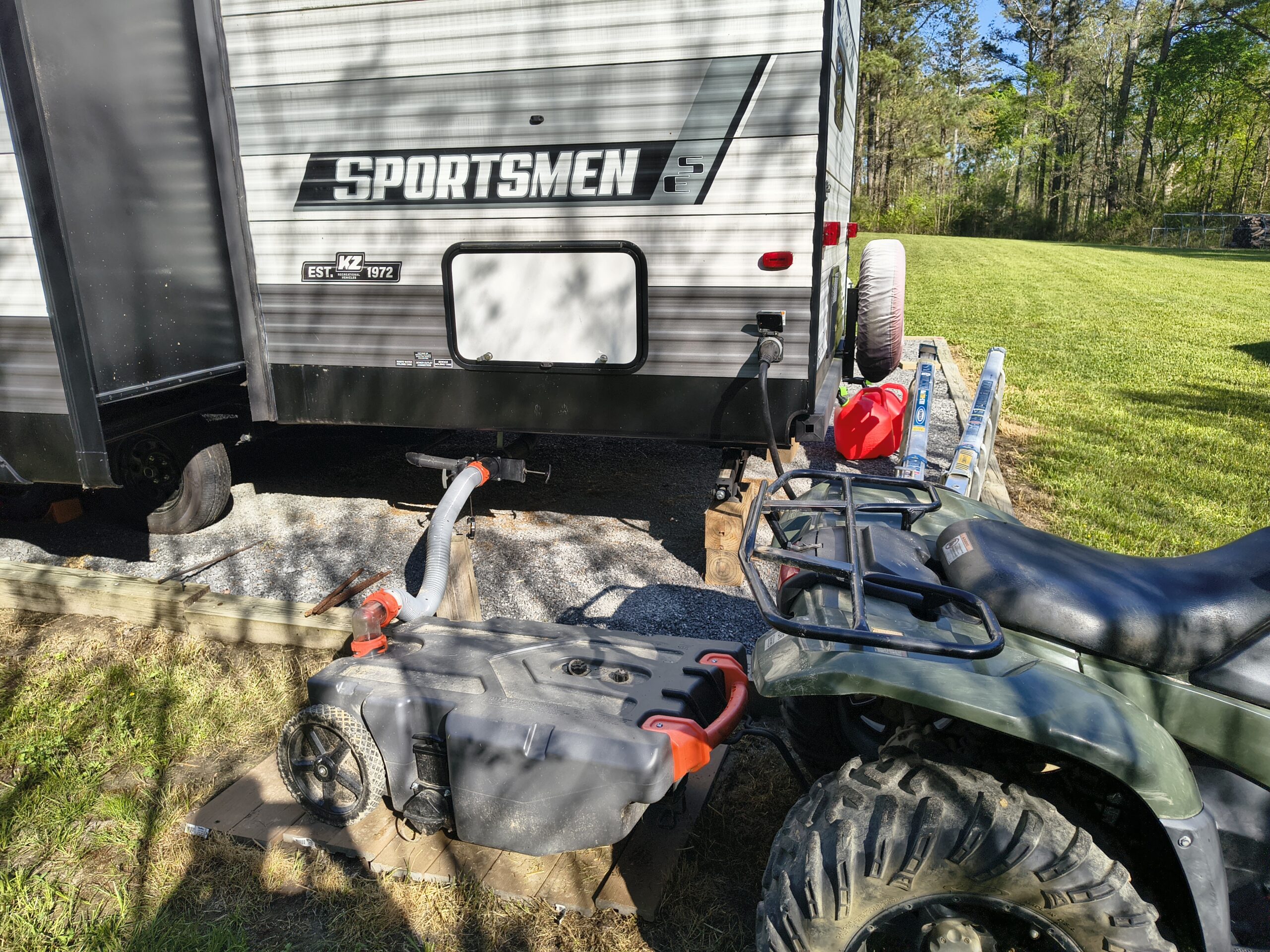
We use a portable waste tote — I call it the poop tote, because that is what it is. It is a gray tank on wheels that holds about 30 gallons. You connect it to the RV drain, open the valve, and let it fill.
Here is the thing nobody tells you: your RV tanks hold more than the tote. The black tank alone is 32 gallons and the tote holds 30. Once you open that valve, you cannot just stop it mid-flow. If you let the tanks fill all the way before dumping, you will overflow the tote. Trust me on this one.
The answer is dump more often. Do not wait until the tanks are completely full. Do it at 75% and save yourself the mess.
Once the tote is full, it weighs about 250 pounds. You are not carrying that anywhere. I hook it up to an ATV and tow it to the dump point. If you do not have an ATV, you are backing your car up to the RV every time. Use whatever you have, but you need something with wheels and a hitch.
The Full Interruption Timeline
This is what the work interruption actually looks like from start to finish:
- Check tank levels — decide it is time
- Finish whatever meeting or call I am on
- Connect the tote to the RV drain
- Dump black tank into tote (carefully — do not overfill)
- Close valve, disconnect
- Hook tote to ATV
- Tow to dump point
- Dump the tote
- Come back, repeat for gray tank if needed
- Refill fresh water (we have a water container on-site, which helps)
- Get back to work
Best case this takes about an hour. If I have to make two trips with the tote or drive into town for fresh water, it can eat half a day.
And it happens every 3 to 4 days. That is a non-negotiable interruption to your work schedule.
How I Plan Around It
After a month of doing this, I have a system. It comes down to project management — the same kind of resource planning I do at work, just applied to water tanks instead of server migrations.
Schedule dump days on light meeting days. I know which days have the fewest calls and I plan the dump around those. Tuesday morning is better than Thursday afternoon when I have back-to-back meetings.
Never let the tanks hit 100%. Dump at 75%. The tote can handle it, you avoid overflow, and it is faster because you are moving less volume.
Keep one day of water reserve. If I think the fresh tank has one day left, I refill that day — not the next morning when I am scrambling before a 9 AM call.
Refill water when doing the dump run. Combine trips. Do not make two separate drives into town when one handles both.
The Water Filter Situation
We carry a Berkey water filter — the plastic travel version. It is one of the best investments we have made for RV life. You can put just about any water through it and it comes out clean and tasting good.
When you are traveling and filling up at different water sources — campground spigots, rest stops, wherever — you do not always know what is in that water. The Berkey handles it. We run all our drinking water through it regardless of the source. For cooking and dishes, the RV tank water is fine.
If you are planning to boondock or travel in an RV full-time, get a water filter. Do not think about it. Just get one.
The Bigger Point
I can run AI agents that build websites, send emails, debug code, and manage three businesses — all from a terminal window over Starlink. That part of my work life is automated and frictionless.
But every 72 hours, I am hooking a waste tote to an ATV and hauling it across a field in Tennessee. That part is not automated. It is not frictionless. And there is no app for it.
The things you take for granted in a house — turn on the faucet, flush the toilet, water just works — those become active projects when you are boondocking. You are managing a resource that has a hard limit and a fixed timeline. That is the reality of working remotely from an RV.
If you are a project manager by trade, you will adapt to this quickly. If you are not, start thinking like one. Your water tank is your critical path, and it does not care about your deadlines.
Coming Next
- Generator Math — what boondocking actually costs in fuel
- The Two-RV Office — why one RV is not enough when two people work full-time
- Mice, Mud, and Meetings — the unautomatable side of remote work
Dominic Ferrara is a Senior IT Manager working remotely from a boondocking camp in Tennessee. He writes about remote work, AI tools, and off-grid life at dominicferrara.com.
Transparency: Articles on this site are written with AI assistance (Claude Code) and reviewed, edited, and fact-checked by Dominic Ferrara based on personal experience. All data points are from actual field measurements and real-world use.
More From the Agentic RVer Series
- Agentic in the Terminal, Manual at the Spigot
- Your AC Will Kill Your Starlink
- Generator Math
- Mice, Mud, and Meetings
- AI for RV Road Trip Planning
Get stories like this every week. Subscribe to AI After 50 — free weekly stories from the intersection of AI, health, and real life after 50.